


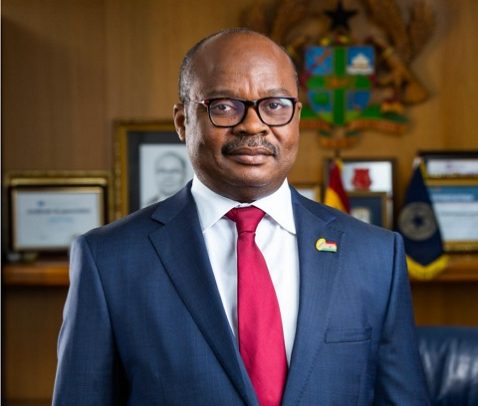
GoldBod and the Domestic Gold Purchase Programme (DGPP) have been embedded within Ghana’s macroeconomic framework and are strengthening the country’s external buffers, Governor of the Bank of Ghana, Dr Johnson P. Asiama has said.
Speaking at the 77th Annual New Year School and Conference of the University of Ghana on Tuesday, January 6, 2026, Dr. Asiama said GoldBod was no longer a conceptual policy idea, but an operational national priority that had reshaped how Ghana captures value from its gold resources during a period of economic stress.
“GoldBod is no longer a concept; it is operational. It is embedded within our macroeconomic framework and has reshaped how Ghana captures value from its gold resources while strengthening external buffers,” the Governor stated.
Dr.Asiama explained that the Domestic Gold Purchase Programme was introduced at a time of acute vulnerability, when foreign exchange buffers were thin, confidence was fragile, and macroeconomic instability posed significant risks to households and businesses.
“The Domestic Gold Purchase Programme was introduced at a moment of acute vulnerability, when foreign exchange buffers became thin and confidence was fragile,” he said, adding that its purpose was “to strengthen reserves, stabilise the currency, and create space for macroeconomic recovery by leveraging Ghana’s own natural endowment.”
He noted that, judged against its stabilisation objectives, the programme played a vital role in restoring confidence and protecting the wider economy, even though it imposed costs on the central bank.
“It is also important to be candid: this stability came at a cost. Since the setup of the DGPP … the Bank of Ghana has had to carry the financial burden of a national strategic policy; one that sought to restore confidence and protect the wider economy.”
According to the Governor, this burden was deliberately assumed in the national interest at a time when macroeconomic instability threatened real incomes, investment, and institutional credibility.
Beyond the gold programme, Dr. Asiama outlined the broader macroeconomic context within which the DGPP was deployed. He said Ghana entered 2025 with elevated inflation, constrained external buffers, weakened confidence and tight global financial conditions that narrowed policy space.
He said the Bank of Ghana responded with firm, but measured actions aimed at restoring monetary and financial stability, protecting the integrity of the financial system, and rebuilding confidence.
“The results are now evident,” he said, noting that inflation eased from above 23 percent into single digits, levels not seen since 2019, while gross international reserves strengthened to US$13.8 billion, equivalent to about 5.7 months of import cover.
“These outcomes matter not as statistics, but because they create space for planning, for investment, and for reform,” Dr. Asiama said.
Turning back to the DGPP, the Governor said national priorities must evolve and that several measures were taken in 2025 to refine the programme and strengthen its governance, transparency and risk management.
He disclosed that the G4O arrangement was cancelled, while aspects of the G4R programme were refined. Settlement risks were reduced through payment-before-release requirements and the ring-fencing of offtake proceeds, while pricing structures were improved through reductions in discounts, agent fees, and assay charges.
He added that the introduction of a Gold FX Auction mechanism had enabled more structured and transparent intermediation of gold-related foreign exchange flows, while GoldBod’s institutional role had strengthened coordination across the gold value chain.
“The relevant question is, therefore, not whether GoldBod should exist, but how it should be governed, refined, and sustained in the national interest,” Dr. Asiama said.
Looking ahead to 2026, the Governor said the G4R programme must be anchored more firmly within the broader Government of Ghana framework as a national priority, with responsibility shared to ensure sustainability does not rest on any single institution.
He announced that the Bank of Ghana, working with GoldBod and the Ministry of Finance, intends to convene a focused policy workshop with experts, market practitioners, and policymakers to further refine the programme in line with best practices.
For more news, join The Chronicle Newspaper channel on WhatsApp: https://whatsapp.com/channel/0029VbBSs55E50UqNPvSOm2z
The post GoldBod Solidifies Ghana’s External Buffers – BoG appeared first on The Ghanaian Chronicle.
Read Full Story




Facebook
Twitter
Pinterest
Instagram
Google+
YouTube
LinkedIn
RSS