

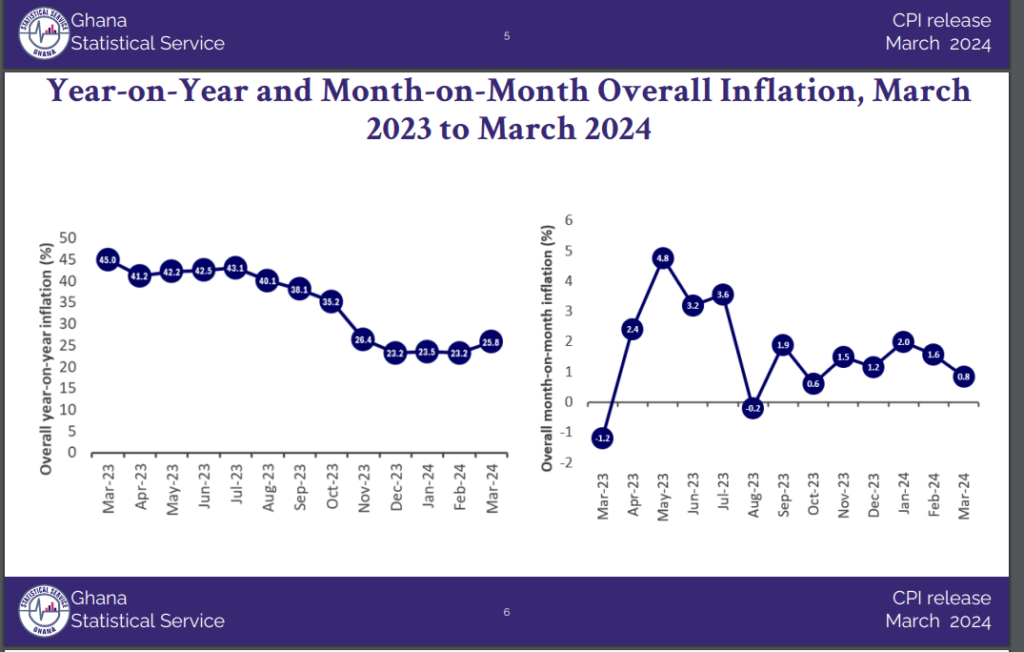
The year-on-year inflation rate slowed for the 11th consecutive month to 6.3 per cent in November from 8.0 per cent in October, the Ghana Statistical Service said on Wednesday.
The November rate is the lowest since price rebasing in 2021.
“The steady drop in inflation from 23.8% in Dec 2024 to 6.3% in November 2025 shows a sustained shift in prices that signals Ghana is firmly on the path to macroeconomic stability,” said Dr Alhassan Iddrisu, the Government Statistician.
He explained that the top five drivers of November inflation respectively were Food and Non-Alcoholic Beverages; Housing, water, electricity, gas and other fuels; Clothing and footwear; Recreation, sport and culture and Alcoholic Beverages, Tobacco & Narcotics which contributed points of 2.82, 1.25, 0.79, 0.45 and 0.31.
“Overall prices increased by 0.9 per cent between October and November. Food inflation fell to 6.6 per cent in November, down from 9.5 per cent in October. Food prices increased by 1.1 per cent between October and November.
“Inflation for goods slowed to 7.3 per cent from 9.3 per cent in October. However, goods prices increase by 1.2 per cent month-on-month.
Since goods account for nearly three quarter of the Consumer Price Index basket, the slowdown in goods inflation is a relief for consumers where it matters most,” he said.
Dr Iddrisu disclosed that services inflation dropped to 3.8 per cent in November from 4.6 per cent in October while Month-on-month services decreased by 0.1per cent between October and November.
“Inflation for locally produced items fell from 8.0 per cent in October to 6.8 per cent in November, while the prices for imported items decreased from 7.8 per cent to 5.0 per cent.
On a regional basis, he explained that North East had the highest regional inflation rate of 12.2 per cent followed by Eastern with 10.8 per cent, Volta with 9.6 per cent, Western with 8.3 per cent and Western North with 7.2 per cent.
“Sharp regional differences persist as Inflation is uneven across the country. North East recorded the highest rate at 12.2 per cent, while Savannah had the lowest at -0.02 per cent. Local supply, transport costs, and market access could be driving these gaps,” he noted.
Dr Iddrisu indicated that five regions contributed to about 79.1 per cent of overall inflation. They included Greater Accra, Eastern, Ashanti, Central and Western regions with contributions of 25.4 per cent, 17.6 per cent, 17.1 per cent, 9.6 per cent and 9.5 per cent respectively.
Dr Iddrisu recommended that businesses take advantage of lower inflation to invest in efficiency, strengthen local supply chains, reduce waste, and pass cost savings to consumers where possible.
It also encourages households to use this period of falling inflation to budget more intentionally, avoid unnecessary spending, and save.
“Government should maintain fiscal discipline, focus resources on keeping food prices stable, and work to reduce regional disparities by improving storage, irrigation, and transport systems,” Dr Iddrisu noted.
Inflation is measured monthly using data on prices of 307 items in the CPI basket purchased by households from 57 markets with 8,337 outlets.
The items are ordered into 13 Divisions, 44 Groups, 98 classes, and 156 sub-classes
Source: GNA
The post Ghana inflation rate for November dips to 6.3% appeared first on Ghana Business News.
Read Full Story




Facebook
Twitter
Pinterest
Instagram
Google+
YouTube
LinkedIn
RSS