
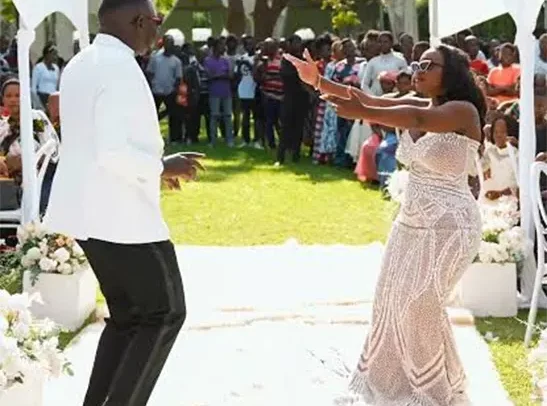

There was a time when the highlight of a white wedding was the exchange of vows before God, family and friends. Today, however, that script appears to be changing. Many weddings appear to reach their climax not at the altar but on the dance floor, where choreographed entrances, viral dance routines and social media-worthy performances often steal the spotlight.
Across the country, a new generation of couples is redefining what a white wedding looks like. The church ceremony, once regarded as the emotional climax of the day, is increasingly overshadowed by a lavish reception featuring choreographed dance routines, cinematic entrances, designer fashion, fireworks and social media content creation. For many guests, the reception has become the “main event,” while the church service serves merely as a prelude.
This shift is perhaps the most striking feature of the Gen Z wedding culture now sweeping across the country.
Modern couples spend weeks, and in some cases months, rehearsing dance routines with their bridal teams. The entrance into the reception has become a production in itself, complete with carefully selected music, synchronised choreography and dramatic lighting effects. Videos of these performances frequently trend on TikTok, Instagram and X, attracting hundreds of thousands of views within hours.
It is not uncommon for a wedding to become a national talking point – not because of the couple’s touching vows or inspiring love story, but because of an energetic dance performance or an extravagant entrance.
The influence of social media cannot be overstated. Weddings are no longer planned solely for those physically present; they are increasingly designed for audiences watching through smartphone screens. Every moment is curated to be “Instagram-worthy” or “TikTok-ready.” Couples hire drone operators, wedding content creators and social media managers whose sole responsibility is to produce short-form videos almost immediately after the ceremony.
Professional photographers and videographers are no longer enough. Today’s weddings often feature content creators who move alongside the couple, capturing behind-the-scenes footage, recording trending audio clips and producing edited reels before the reception even ends. In many instances, the first viral video appears online before some guests have left the venue.
The result is that the wedding becomes both a private celebration and a public performance.
The transformation extends far beyond videography. Bridal parties have evolved into carefully coordinated ensembles. Bridesmaids and groomsmen rehearse dance routines, wear matching designer outfits and participate in elaborate entrances that sometimes rival those of the bride and groom themselves. Instead of serving merely as witnesses, they become performers contributing to the overall entertainment.
Fashion has also taken centre stage. Many brides now wear multiple outfits during a single wedding day, which is a traditional church gown for the ceremony, an elaborate reception dress and another outfit for the after-party. Grooms similarly switch from tuxedos to tailored kaftans or designer suits as the celebrations progress. Each wardrobe change provides another opportunity for photographs, videos and online engagement.
The pursuit of visual excellence has given rise to celebrity-style productions. Luxury vehicles, indoor fireworks, LED dance floors, smoke machines and sophisticated lighting have become common features of high-profile weddings. In some exceptional cases, horse-drawn carriages or helicopters are incorporated to create unforgettable entrances.
Pre-wedding activities have also become productions in their own right. What was once a simple photo session has evolved into cinematic storytelling involving multiple locations, costume changes, scripted scenes and drone footage. These productions are often released days or weeks before the wedding, generating anticipation similar to the promotion of a movie premiere.
Technology has further transformed the guest experience. QR-code invitations have replaced many traditional invitation cards. Weddings now feature customised hashtags, Instagram filters and live streaming for relatives abroad. Guests are encouraged to share photos using official hashtags, ensuring that the celebration trends online throughout the day.
This digital culture has created a booming wedding economy. Event planners, decorators, fashion designers, make-up artists, drone operators, MCs, DJs, content creators and social media editors have all found new opportunities in the expanding wedding industry. Weddings have become major economic events supporting thousands of livelihoods.
Yet beneath the glamour lies an important question.
Has the celebration begun to overshadow the purpose of the celebration?
Some observers argue that weddings increasingly resemble entertainment concerts rather than sacred ceremonies. Dance competitions, comedy performances, singing acts, flash mobs, games and audience participation often dominate the reception programme. Guests sometimes remember the choreography more vividly than the marriage vows themselves.
Others point to the growing pressure on young couples to stage extravagant weddings in order to meet social expectations or achieve viral success. The pursuit of the so-called “soft life” has encouraged displays of luxury, including expensive décor, imported flowers, premium venues and designer fashion. Industry experts have warned that some couples stretch their finances beyond reasonable limits simply to project an aspirational lifestyle online.
Another concern is the changing perception of marriage itself. Academic research suggests that some younger couples increasingly regard the white wedding as the “real” marriage, with the traditional engagement viewed merely as a preliminary step. While this reflects the influence of Western wedding traditions, it also raises broader questions about preserving Ghana’s own cultural heritage.
Still, it would be unfair to conclude that Gen Z has diminished the institution of marriage. Rather, this generation has embraced technology, creativity and visual storytelling to celebrate one of life’s most important milestones in ways previous generations never imagined.
Every generation reshapes tradition according to its own realities. Today’s couples simply happen to live in an era where moments are measured not only by memories but also by digital impressions, viral videos and online engagement.
The challenge, therefore, is not to reject innovation but to preserve perspective.
Dance, fashion and entertainment undoubtedly add colour to weddings. Social media allows loved ones across continents to share in joyous occasions. Creative productions provide lasting memories that couples will treasure for years.
However, when the choreography receives more applause than the covenant, when the reception commands more attention than the vows, and when viral content becomes more important than lifelong commitment, society must pause to reflect.
After all, a successful marriage is measured not by the number of views a wedding video receives, but by the enduring strength of the union long after the music has stopped, the cameras have been packed away and the hashtags have faded from the trending list.
By Adelina Fosua Adutwumwaa
Read Full Story





Facebook
Twitter
Pinterest
Instagram
Google+
YouTube
LinkedIn
RSS