


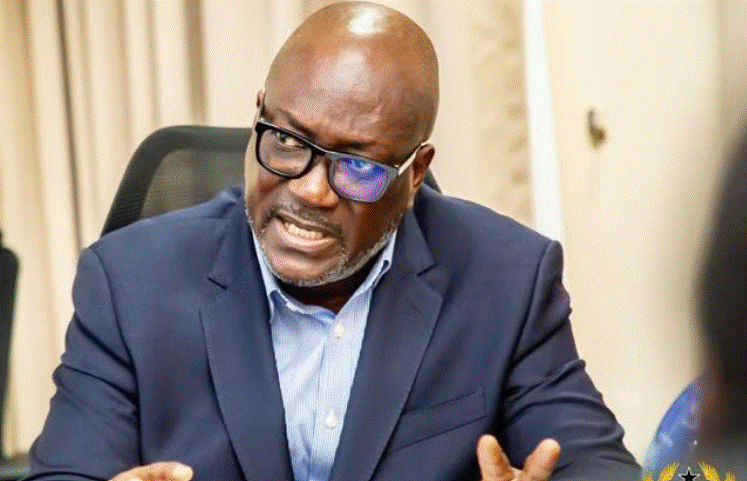
The Governor of the Bank of Ghana (BoG), Dr. Johnson P. Asiama, has told journalists in Accra yesterday that whether inflation, which currently stands at 3.3% would rise or not, depends largely on developments in the global oil market, particularly the situation in the Middle East.
Responding to a question at the Monetary Policy Committee (MPC) press briefing, he noted that a sustained increase in crude oil prices could reverse some of the gains made on inflation.
“Certainly, if global oil prices surge, that will impact prices here in Ghana and as you are aware, it feeds into domestic inflation,” he said, adding that the Central Bank remains vigilant and ready to respond, if conditions change.
However, he was quick to assure that Ghana is in a stronger position to withstand such shocks due to improved external buffers.
“The good thing is, we have accumulated enough reserves, nearly 5.9 months of import cover, which should allow us to protect the gains going forward,” he stated.
The Bank of Ghana has reduced its Monetary Policy Rate (MPR) by 150 basis points to 14%, citing sustained disinflation, improving economic activity and strengthening macroeconomic fundamentals.
“In the view of the Committee, despite the upside risks to the inflation outlook, the favourable domestic macroeconomic conditions and the high prevailing real interest rates provide scope to ease the policy rate further. Consequently, the MPC decided to reduce the monetary policy rate by 150 basis points to 14%,” the Governor stated, explaining that favourable macroeconomic conditions and high prevailing real interest rates created room for a gradual easing of the monetary policy stance.
The rate cut follows a consistent decline in inflation over the past year, with headline inflation dropping to 3.3% in February 2026 from 5.4% in December 2025. Core inflation also eased, reflecting subdued underlying price pressures.
Concerns were also raised about whether the rate cut was risky given rising geopolitical tensions. But Dr. Asiama dismissed such fears, insisting that the decision was based on careful and extensive analysis by the Committee.
“Not at all,” he said in response to a question adding “we have gone through a lot of material, evaluated the outlook, and assessed developments across sectors.
“The banking sector is now solvent, liquid, and expanding, while private sector credit is beginning to recover.”
He explained that declining interest rates are expected to further stimulate lending and support economic expansion. “With the general level of interest rates coming down, the policy decision taken today should support higher levels of private sector credit,” Dr. Asiama added, revealing that some borrowers are already accessing loans at rates as low as about 11.7%.
The Governor also addressed concerns about foreign exchange management, particularly regarding commercial banks’ Nostro accounts, which had previously been linked to dollar shortages in the system.
In response to a question on the issue, he said the central bank has intensified monitoring of foreign exchange inflows to ensure they are used appropriately.
“We are making sure that these inflows, wherever they are held, are used to support legitimate imports into the country.
“The new forex framework is working very well, and we are seeing remittance inflows return through the banking system,” Dr. Asiama noted.
On broader external sector developments, he indicated that Ghana’s position remains strong, supported by improved trade performance and rising reserves.
The country recorded a trade surplus of $3.7 billion in the first two months of 2026, compared to $2.1 billion during the same period last year, largely driven by higher gold export earnings.
Meanwhile, gross international reserves rose to $14.8 billion, providing a solid buffer against external shocks and supporting relative stability of the cedi.
Responding to a question on potential concentration risks associated with the Bank’s reserve accumulation programme, the Governor clarified that the strategy is diversified.
“It is not only about gold. There is also a focus on scaling up non-traditional exports. The programme has been carefully designed, and we do not see concentration risks as a major concern,” he explained.
Domestically, economic activity continues to show strong momentum. Ghana’s economy grew by 6% in 2025, while non-oil GDP expanded by 7.6%, driven by services and agriculture.
The Bank’s Composite Index of Economic Activity also recorded strong growth of 8.4% in January 2026, reflecting increased industrial output, credit expansion, and trade activity.
Business and consumer confidence have improved significantly, with firms expressing optimism about future prospects and households showing increased confidence amid easing inflation.
The banking sector, the Governor noted, is also on a path of recovery, with total assets rising and financial soundness indicators improving across profitability, liquidity, and solvency. Although the non-performing loans ratio remains relatively high at 18.7%, it has declined from 22.6% a year earlier, with the central bank implementing additional measures to further reduce it.
The Governor maintained that Ghana’s macroeconomic outlook remains positive, supported by strong growth, easing inflation, and improved financial sector stability.
He reiterated the Bank’s readiness to act should conditions change, particularly in response to external shocks.
“We will continue to monitor developments closely and take the necessary policy actions to safeguard the gains achieved so far,” he assured.
For more news, join The Chronicle Newspaper channel on WhatsApp: https://whatsapp.com/channel/0029VbBSs55E50UqNPvSOm2z
The post Ghana Is In A Stronger Position To Withstand External Shocks –BoG appeared first on The Ghanaian Chronicle.
Read Full Story




Facebook
Twitter
Pinterest
Instagram
Google+
YouTube
LinkedIn
RSS